

Most of your speakers are white women; it stands out as a glaring oversight in the context of your event” – Moving Beyond Surface Representations
- Allison Davis

- Feb 18, 2024
- 6 min read
Updated: Feb 20, 2024
As I gear up for my upcoming event, the "Beyond Comfort Zones: The Real-Talk DE&I Summit," inspired by my book, "Beyond Comfort Zones: The Real-Talk Approach To Diversity, Equity, And Inclusion," I'm reminded of the journey that led me here and why I do the work I do.
If you read my book then you know, if you haven’t yet, I’m not mad, just disappointed.
Basically I worked abroad for a company that said they wanted more diversity, more specifically young international women to all of which I was (and still am by the way).
When I got there, I realized that the organization didn’t even have the infrastructure to handle international employees let alone the right culture that was capable of including them.
In my first role, I was primarily used for my English language skills, and therefore my primary responsibility became a newsletter. After my first submission, I was asked by my supervisor, the head of global marketing, if I was stupid because I was unable to spell in my own language. I was using American English versus British English.
I think that says enough about their grasp on diversity and inclusion.
In my second position, I found myself with minimal tasks as my supervisor, also a foreigner, was grappling with similar consequences of exclusion as I encountered.
I became so frustrated with my working experience that I approached the company lawyer.
He placed me in a third role that started off promising. I was finally being developed and had tasks… until the other girls on my team decided they didn’t want to work with a foreigner and refused to speak English (the company’s official language). I was eventually phased out of the team due to the lack of effective collaboration and was being given a full time salary for doing nothing.
I became so furious about my situation that I spent my time doing a diversity study for the organization that ended in 10 behaviors for the organization to be more inclusive.
Spoiler alert: It never progressed because, at that time, I was too consumed by resentment to foster any constructive outcome. In response, the company merely initiated a diversity campaign, which predictably failed to enhance the culture for diverse hires.
After I left that organization, I went to South Africa to continue to study DE&I within an extreme case.
The recurring theme I discovered in both my research and personal experience was that despite the efforts of organizations worldwide, and even despite the best intentions, so many continue to fall into the same pitfalls, time and time again:
Inauthenticity
Superficial DE&I efforts, only for looks
Rushed, appearance-focused measures
Lack of commitment to long-term efforts to foster organic diversity
Reactive vs. Proactive
Only working on DE&I when there is a problem/conflict
Getting stuck in reactive cycles
Lack of ongoing efforts to address bias and inequality in the workplace
Limiting Diversity
Limiting diversity to overt physical differences
Lack of awareness to beyond surface level characteristics
Lack of trust and understanding necessary for inclusivity
Neglecting Existing Diversity
Behaving exclusively, leading to decreased performance and diminished employee well-being
Not unlocking true potential through sincere inclusion
Haphazard Initiatives
Allocating resources to temporary fixes that fail to address underlying problems
Insufficient testing prior to implementing solutions
Imbalanced Accountability
Assigning DE&I responsibility to one individual or department and expecting universal commitment
Insufficient engagement across the entire organization to drive change
I've since channeled my own experience and research into action to help other organizations avoid the same mistakes.
The work that I am doing now comes from a place of logic and love, with the intention of flipping the script on DE&I and helping companies become more inclusive, equitable, and therefore organically more diverse.

So now that you have context about me and what I am doing, it’s time to explain the controversy behind the title of this blog.
I have been posting all over LinkedIn, and directly messaging anyone and everyone to participate in this summit I am hosting on March 8th because I truly believe in this movement. Through my outreach, someone promptly sent me this message back:
“While I appreciate the offer to participate in this event, I feel moved to share a concern: I notice that 5 of the 6 speakers advertised are white women. While I am certain that they are each accomplished experts and have value to offer, it stands out as a glaring oversight in the context of your event - Diversity, Equity and Inclusive Leadership.
The work of DEI deeply affects women, yes, but very strongly impacts people of colour globally.
That 5/6 speakers are white women, seems rather unbalanced in world where decentering whiteness is at the heart of DEI work and certainly the pain point in many corporations. Sadly, the global majority has been marginalized for too long in favour of white expertise.
I believe this to be something important to bring to your attention, uncomfortable as the fact is to address.
I will not be taking up your offer for now. I wish you every success in your event and DEI journey.”
My heart sank when I read this.
My initial observation was that they hadn't thoroughly read or grasped the essence of my event, which they later confirmed in the conversation.
Instead, they had swiftly jumped to the speaker line up and solely focused on scrutinizing the representation aspect.
My second thought was how unfair this call out was.
I am starting something from nothing and literally out here hustling, asking anyone and everyone I can to participate. Everyone is invited to this party.
I feel incredibly blessed to have the speakers I do because I do not have a massive budget to pay them first of all, so they are choosing to be part of this movement because they genuinely believe in it. And this lineup actually isn't just a bunch of white women—it's a whole mix of folks from around the globe that have incredibly diverse backgrounds, experiences, and perspectives they bring to the table.
Among our lineup of speakers, we have multiple individuals who are people of color, mothers, men, individuals with physical disabilities, and even neurodiverse individuals, and those are just the superficial characteristics I'm mentioning.
More importantly than their physical appearances, they'll be addressing topics such as compassion and love in the workplace, paternity leave, anti-violence, gender equality, representation, and more.
So, to doubt the inclusivity of my event is truly astonishing to me. It would be impossible to comprehensively address every facet of diversity, equity, and inclusion (DE&I) within a four-hour timeframe, let alone meet every attendee's specific expectations for representation. Personally, I'm uncertain what exact combination of physical attributes would be deemed satisfactory.
The final thought I am choosing to end on, is that this is exactly why I am doing the work I am doing.
This superficial expectation and definition of diversity and lack of understanding and therefore inclusion in the name of diversity is precisely why DE&I hasn’t been working.
DE&I has gotten so muddied up, and become so image focused, that we have actually lost track of the human element and somewhere along the lines seem to have stopped questioning what we believe in or what we're working towards.

While I highly value diverse perspectives and feedback, it was crucial for me to address their misconception regarding the inclusivity of my event. This challenge mirrors the broader struggles organizations face worldwide when organizing events, advertising, or making even every day business decisions.
I wholeheartedly acknowledge the importance of identifying reoccurring patterns that may indicate bias, however, reshuffling a speaker lineup or seeking out individuals solely to conform to an idealized image of diversity would falling directly into one of the pitfalls and compromise authenticity. I selected topics and qualified individuals based on merit, resulting in an organic diversity that I refuse to compromise merely for the sake of aesthetics.
I have never felt stronger about this work and implore you, if your organization has been under fire for DE&I or if you resonate with this at all, please come on March 8th.
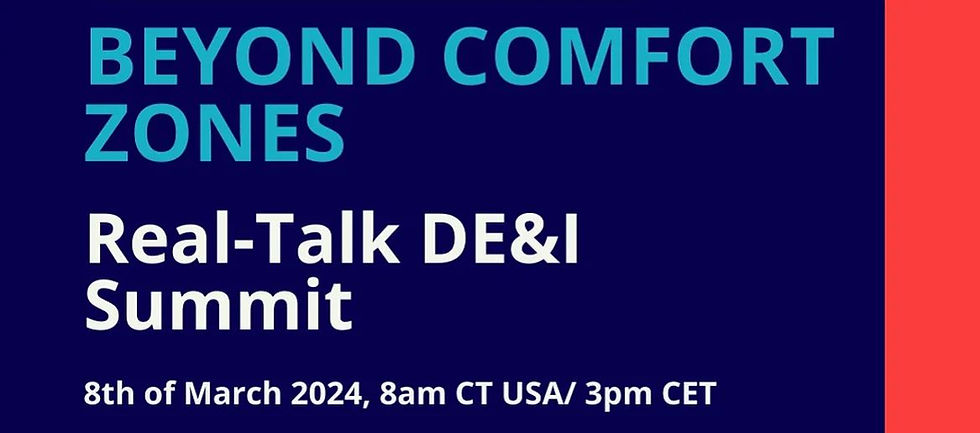
This event isn't about tokenism or optics; it's about fostering meaningful, respectful dialogue and genuine change.
Join me on March 8th for an event that goes beyond buzzwords and surface-level diversity.
Let's rewrite the narrative of DE&I, reconnect with the human element, and pave the way for a more inclusive tomorrow.
Together, we'll navigate the pitfalls, explore successful case studies, and chart a course back to the basics of inclusion.
Are you ready to be a part of the change?



Comments